Tuesday, October 13, 2015

Sunday Bloody Sunday (1971)

"I've had this business of anything is better than nothing. There have got to be times when nothing is better than anything." --Alex (Glenda Jackson) 

Today I felt compelled to view and write about one of my (new) all-time favorite movies, Sunday Bloody Sunday. The plot of the film is simple yet provocative: Alex Greville (Glenda Jackson), a straight woman, and Daniel Hirsh (Peter Finch), a gay man, are each having an affair with the same man (Murray Head). Here is the trailer, which definitely serves the movie's themes well: 


The first time I watched this film was only back in July. I was ill that day and bedridden, and, as a Glenda Jackson fan, I had checked this film out from the library on a whim. There are only a handfull of times in which I was watching a film and wished it would never end; Sunday Bloody Sunday is one of those films. The characters' lives, fears, anxieties, and frustrations are so real, so palpable, that I could not tear myself away. As soon as it was over, I grabbed my laptop and ordered myself the blu ray.

Sunday Bloody Sunday is often touted as being one of the most moving films about relationships, but to me this is actually the best movie about living alone I have ever seen. In Alex and Daniel, we see two intelligent, hard-working people who have both...settled. Bob, the lover, is a shallow, self-absorbed loser in many ways. There are some who have criticized the film for having two such complex people in love with such a bozo, but I think that's the point: throughout the film, which takes place over the course of only about ten days, we see Daniel and Alex both sampling what they want from relationships--children, stability, romance--but they never quite make it there. It makes sense for them both not only to accept Bob's greedy terms--that they have to share him, essentially--but also that they fall for him. 

Both Alex and Daniel feel so real in this film; I identified with Alex so strongly--perhaps more than any other character in a movie--and Glenda Jackson plays her with a blend of toughness and vulnerability. (Also, the fact that Alex takes all of the books in her divorce and nothing else--and that her family is puzzled by this--felt like something I would do. I've never been married, let alone divorced, but I completely understood that one!)


The first half of the film takes place over one weekend in which we see Bob alternating between Alex and Daniel. Alex has agreed to babysit her sister's children, all FIVE of them, while the sister, her husband, and a professor all go away for the weekend. At the suggestion of her sister, Alex decides to bring Bob along for what she calls "a proper weekend." She rushes out the door when we first see her character on a Friday night, tossing her dirty coffee cup into the sink and tripping over her ashtray, which she just leaves on the floor. The children are loud as can be and almost out of control, but so very cute. The eldest, Lucy, who appears to be about 10, is the one with whom Alex identifies, as we come to see later. 

Watching this movie for the seventh or eighth time (I've lost count), I did catch some new things. For one, when Alex is rushing out the door, she grabs what I realized tonight were children's books and stuffs them into her bag. She seems incredibly happy when she and Bob are watching the kids together: she plays with them outside, cuddles them, and seems blissful. It is when Bob suddenly leaves, however, on Saturday evening, that we see this all fall apart. Bob leaves to go to Daniel--of whom Alex is very aware--and Alex is devastated. Later, she makes fudge for the children, but eats some of it herself, sitting alone, crying. She tries to cuddle one of her other nieces, who only wants to get back to playing. The self-imposed isolation as a result of Bob's abandoning her reinforces the fact that this dream life--house, kids, husband--is something that will forever be out of her reach. Indeed, the next day, Sunday, we see a similar fate, which Alex and Bob take the children to the park, only to have something tragic happen, which prompts Alex to have flashbacks--done most appealingly by director John Schlesinger--in which she identifies with Lucy. Also, a bit of trivia: the park scene marks the film debut of...Daniel Day-Lewis! He's about 14 years old here, playing a little punk who scratches up cars (at 1:35):


Despite her divorce, Alex still wears her wedding ring, which is a emblem of how frozen she is. She works at a job she hates and spends much of the film composing her resignation letter; she is watching children she genuinely loves but who don't belong to her; her boyfriend is involved with another man; and her parents, we see later, want her to return to her ex-husband. Yet, Alex remains a resilient character; she endures the painful journey of this film in which she learns it is possible to reject the sentimental lie about the glories of domesticity and be okay. As the quote at the beginning of this review sums up: "There are times when nothing has to be better than anything."

Daniel is in a similarly trapped position. As a Jewish doctor whose family, as we learn during his nephew's Bar Mitzvah, has no idea he is gay, he seems to exist for the sake of other people. Patients call him and pop into his house frequently, and he always puts his own life aside for them. Much like Alex identifies with Lucy, Daniel is reminded of his own Bar Mitzvah, which provokes powerful memories. When he is at the nephew's party, which is nothing short of a gala, Daniel is isolated in the crowd, so to speak. His family has seated him next to a woman in the hopes he will "finally" have a girlfriend...much like Alex's sister wants her to have a weekend alone with Bob and the children. And neither situation leads to any sort of "happily ever after."

This film is revolutionary in many ways, but especially in the honesty with which it portrays a gay couple. There is a passionate kiss between the two of them, one that was shocking in its day, and we see Daniel and Bob in bed a few times. One of the most significant revelations of this film is that Daniel is a man first and a gay man second. Truly, throughout the film his sexuality feels almost irrelevant; instead, the audience is invested in his feelings, struggles, and, ultimately, disappointments. In a way, Sunday Bloody Sunday may be more important to the portrayal of gay people in film than Brokeback Mountain. 

As I said earlier, Sunday Bloody Sunday is the best movie about living alone that I have ever seen, and I stress this because although the movie centers on the "relationship among three sensual people" (as the tagline from the 70's goes), it's really about the failure of this relationship. Daniel and Alex are isolated and alone; they never quite fit in among their families or their friends, and neither of them find any kind of "true love" by the film's end. One of my favorite scenes is when Alex returns to her apartment after being with the children all weekend. After being bombarded constantly with so much noise and chaos, she is now completely alone; her apartment is silent--uncomfortably silent. She enters and sees her dirty dishes still in the sink. She scans the room, taking in the mess and the quiet, after which she spots her turned over ashtray, picks up the cigarette butts, and rubs the ashes into the carpet with her foot while the screen fades to black. This is a powerful image to me; as an aunt who lives alone, I could fully understand the weight of emotions flooding her in that scene. It's so simple, but so relatable and real. 

Sunday Bloody Sunday is one of the truest films I've ever seen, which is something absent from today's movies. The only stories we ever see are what I call "man movies": comic book films, biopics about white men, or true stories about white men. I'm at a loss trying to think of a film from the past five years with a woman character half as complex as Alex Greville--or even a man half as complicated as Daniel. There are no stories (and certainly no original stories) in today's films about everyday life. Nothing. 

Sunday Bloody Sunday is a masterpiece. Truly, the depth of this film cannot be overstated. I have barely begun to scratch the surface of this beautiful film, despite my lengthy review. It's a beautiful, sensual, and sentient film about two people who have allowed themselves to settle. 

Grade: A+


Sunday, October 11, 2015

Whore (1991)

I'm just gonna say it: I'm a Ken Russell fanatic. 

In the seventies, Ken was unstoppable: Women in Love, The Music Lovers, The Devils, Savage Messiah, Mahler, Tommy--all of these films are masterpieces. I would go so far as to argue no other director had a more innovative, artistic, and masterful run of movies in the seventies than he. Granted, there are a few contenders--Martin Scorsese and John Schlesinger come to mind--but not even those two could touch Ken's creativity and innovation, which is what makes the critics' vilification of him puzzling and infuriating. Roger Ebert and Pauline Kael, for instance, constantly savaged his movies, branding him "extravagant" and "eccentric." In fact, Kael said she thought Ken should have a stake driven through him for The Music Lovers. As a result of so much vitriol, Ken had increasing difficulty getting funding in the eighties and by the nineties was considered washed up, a "has been." 

Poster for Whore
For Russell fans, watching his late work is like watching an angel fall. There are nuggets of brilliance, but the cracks left by shoestring budgets from the late 80s on is palpable and leaves those of us still fawning over his early work feeling mournful. Whore is one prime example of this. 

It's worth noting Whore was released the same year as Pretty Woman, a film Russell despised for its cheesy glamorization of prostitution. Indeed, Whore does not glamorize anything about the oldest profession. It's a stark, unflinching look at the world prostitutes inhabit, the title being perhaps the most blatant aspect. 

The film stars Theresa Russell (no relation to Ken) as Liz, a prostitute who is trying to escape her pimp and find a better life. The film takes place over the course of one day, giving the audience a glimpse into what her life would be like, while telling her life story through flashbacks. The entire movie is edited in rondo, much like Ken's experimental (and, to me, brilliant) film Mahler. This style works on many levels, and I was deeply moved by the contrast between where she is in the present and what happened to her in the past. 

The most innovative part of this movie is the narration: Liz looks directly into the camera for much of the film, which positions Whore as probably the only feminist look at prostitutes I have seen in a movie. 

In 1975, Laura Mulvey crafted the term "the male gaze" in her essay "Visual Pleasure and Narrative Cinema" to refer to the way women are depicted in film...and how the audience views them. She basically argues women are presented as objects of the male characters; they exist only to show the men's feelings or conflicts; they have no character of their own. She also says women are objectified by the audience, too--even if women are in the audience--because we view the women on screen just as the men in the film do. Of course, I'm oversimplifying, but for the purposes of this review, these are the most important things to take away.

bell hooks, one of America's best feminist theorists, writes of the "oppositional gaze," arguing women have the power to look back. This is exactly what Whore does so well.

Think about the representations of prostitutes we've encountered on film: Julia Roberts in Pretty Woman, Shelly Long in Night Watch. These women are filmed so that we view them through Richard Gere's and Henry Winkler's eyes--indeed the eyes of everyone else in stories! They exist to be pretty, sexy, but still have hearts of gold. They are not supposed to have any value in the movie other than showing us what the male characters are going through. It's an exploitative, misogynist presentation of women and perhaps the most misogynist of all: not only are they objectifying women, but they are objectifying female characters whose existence depends on exploiting their bodies and their sexuality. 

In Whore, Liz stares directly into the camera, challenging you to see her as an object. She recounts horrible stories, the most terrifying being when she accepts a customer who is in a van, only to be beaten and brutalized. In that scene, and in fact for almost all of the movie, we do not see Liz naked at all. We see her pulled behind a curtain and we hear her scream and the sounds of punches, but we don't see it. This was a subtle but provocative choice on Ken's part because it places the emphasis on the terror of the situation, not only Liz's body. Her voice narrates the scene as well, which enables Liz to have power over how we as the audience interpret the scene and makes the two men's voices completely irrelevant. This simple choice actually challenges the male gaze and puts the woman at the center of the storytelling. 

The entire film is shot this way. In fact, few characters other than Liz even have any dialogue. She gradually digs farther and farther back into her past, revealing her marriage to an alcoholic abuser, how she escaped him with her little boy, and how she became a prostitute. The most moving parts of the film are definitely when she talks about how her son is in foster care. There is nothing sanitized about this presentation, which I found refreshing and quite moving. 

Casting Theresa Russell was an effective choice, as well. Rather than casting someone who looks like a movie star, like Julia Roberts, Ken's choice of Theresa brings more realism to the story. Theresa was not skinny and looks like someone you might know. She also brought a brashness and edge to the character, making Liz truly seem like a woman who has a rough life--a quality that strengthens the movie.

The few qualms I have with the film undoubtedly were the consequences of the minute budget in which Ken had to operate. The music is too over the top in scenes in which Liz's violent pimp shows up, and there are a few wacky scenes in the present day portions of the movie. 

One narrative problem is the fact that, at least an hour into the movie, after we have become accustomed to Liz telling her story, the pimp has a few minutes in which he talks to the camera. It felt out of place and, most important, at odds with the powerful oppositional gaze we have come to relish from Liz. Still, the pimp's dialogue is revolting and reflects just how evil and abusive he is. In a way, one could argue this brief interlude with the pimp is Ken's way of truly denouncing the male gaze: we are forced to look at Liz just as the pimp does, and it makes us queasy and guilty because we have come to see her as a person. 

When Whore came out, it was given a NC-17 rating although Pretty Woman was rated R. Ken felt he was being punished for telling the truth, and he did have a point. However, Whore is about reality, and I'm not sure anyone under 17 should watch this film--not because it's shocking, and not because of nudity (of which there is little), but because the subject matter is handled so unapologetically and so blatantly. Frankly, The Wolf of Wall Street is far more explicit than Whore, but Whore's embracing of a prostitute's reality and its forcing the audience to examine their own prejudices is more unsettling than anything in The Wolf of Wall Street. 

Whore has some structural issues and does feel like it was made with very little money, but it definitely has value. It is not Ken Russell's best--not by a long shot--but it is a worthy contribution to his canon. 

Grade: B-

Saturday, October 3, 2015

Raging Bull (1980)

Last night I watched Raging Bull for the fifth or sixth time (I have lost count), and I still have at best mixed feelings about it. From a directing standpoint, an editing standpoint, an acting standpoint, a cinematography standpoint--truly, any aspect of filmmaking--Raging Bull is a masterpiece. However, there is something missing from the film for me that weakens its pathos and overall emotional pull. At just over two hours, it feels much longer. It is a beautiful film in many ways, but may also be the most violent film Martin Scorsese has ever made by a tremendous margin. 

Released in 1980, which was the same year of David Lynch's The Elephant Man, Robert Redford's directorial debut in Ordinary People, and Sissy Spacek's lovely performance in Coal Miner's Daughter, Raging Bull certainly was in good company. I've seen all of these movies and enjoy them all for different reasons, but Raging Bull is the one that haunts me the most, and not for necessarily good reasons. 

The film chronicles real life boxer Jake LaMotta's rise and fall in his boxing career, and it is a brutal, agonizing decline. Robert De Niro, whose performance is perfection here, got into incredible shape for the boxing sequences, then gained over 60 pounds to play LaMotta in his later years. It is a breathtaking transformation and one that anyone even mildly interested in acting or film must see. He captures LaMotta's anger, stupidity, paranoia, and (in my opinion) personality disorder flawlessly. One of the most perfectly shot, edited, and acted scenes is his final fight with Sugar Ray Robinson. If you've never seen this film before, you must watch this:


The editing in this scene is brilliant. Spike Lee points out that one of the greatest things about this movie is the boxing choreography, and it is perfect. The cuts of the lights, the punches, the blood--we learn so much about LaMotta as a person through these boxing sequences, and none more than in the clip above.

Although Raging Bull is recognized as one of the great collaborations between Robert De Niro and Martin Scorsese, many people fail to realize this was the first in a long and masterful line of collaborations between Scorsese and Thelma Schoonmaker, who is without a doubt one of the great editors of the sound era. If you feel I'm overstating, just watch this interview with Scorsese and Wang Kar Wai in which they both gush over Schoonmaker's talent (13:00 minutes in):


Since 1980, Thelma has edited all of Scorsese's movies and now practically has a telepathic relationship with him. She's been nominated seven times for Best Film Editing, and she's won three Oscars--the first of which was for Raging Bull (The Aviator  and The Departed were her other wins). For some reason, every self-described feminist I know who is interested in film does not know anything about Schoonmaker, which bewilders me and speaks to how much editors are overlooked, especially women. In any case, Scorsese and Schoonmaker's collaboration on Raging Bull is nothing short of ingenious. The cuts on the Sugar Ray sequence are of course only one small example.

This film also marks the first collaboration between Scorsese and Joe Pesci. Anyone who is familiar with their later work, particularly Goodfellas and Casino, knows that in the Pesci-De Niro relationship, De Niro plays the calm one and Pesci the psychopath. In Raging Bull, the relation is much the opposite, with Jake LaMotta as essentially a paranoid, narcissistic psychopath (he is a "raging bull") and Pesci as the slightly more level-headed brother. Truly, Raging Bull is an American Othello, with LaMotta constantly suspecting and punishing his Desdamona, played by an extremely young Cathy Moriarty. 

So, with all of these accolades, why do I dislike this movie?

It's complicated. The first time I watched this film was in the midst of my and my brother's obsession with Scorsese's Goodfellas, which you can read about on my "About Me" page. We were in love with anything even remotely associated with Scorsese and wanted to see Raging Bull as soon as we knew what it was. I still remember Burt and me watching it on an old TV in our living room and both of us feeling...confused by the end. I don't know what I expected, but I do remember feeling let down. Because I was only about 17 at the time, it is easy to dismiss my initial reaction to youthful ignorance. However, I've watched it since then several times and always carry that same feeling of...disappointment. After watching the film last night, I am finally able to articulate that disappointment. 

Jake LaMotta is a character consumed by violence; it defines every fiber of his being: his masculinity, his passions, his home life, his career, his treatment of his family. He is a man who is drowned in violence, defined by it, driven by it, aroused by it. As a result, every single scene of the film is at the very least tinged with this violence. Watching the film last night, I felt emotionally exhausted only thirty minutes into the movie, and it was then that I realized why. 

The film puts you inside the mind of a man--a "raging bull"--whose obsession with violence permeates everything about him, and it fills the audience with anxiety, fear, and trepidation. You have no idea whom he is about to attack, what he will break or destroy, or to what extent he will explode. He is a ticking time bomb in the most extreme. If you look at other Scorsese protagonists, this is not an unusual characteristic; in fact, it is quite common. Johnny Boy in Mean Streets, Travis Bickle in Taxi Driver, Nicky in Casino, Tommy in Goodfellas--all of these guys are on the brink of explosion. For me, the difference is that LaMotta was not only a real person (this is a biopic, after all), but his anger and intensity feel so real. It is because of this constantly pulsing violence throughout the entire film that I believe Raging Bull is the most violent film Scorsese has ever done.

I can only speculate about how men feel watching Raging Bull, but for me as a woman, I feel anxious and tired the whole time. Although I have never been in a violent relationship, I have been on the receiving end of that kind of attitude LaMotta exudes: women as property, women as sexual objects, women as things. Indeed, every woman alive (and most girls) have been subjected to sexual harassment at some point (usually quite frequently), and the Jake LaMottas of the world are the ones we fear most of all. 

One scene in particular that made me feel queasy--in a way it did not when I was a teenager--was toward the end. LaMotta has a club and is quite fat and creepy at this point. He walks around the club kissing girls who may or may not be underage as a way to "test" and see if they are 21. I had to stop the film and walk around for a moment to calm down; De Niro's performance in that scene is so real, it provoked memories of every creepy, lecherous old man I've met at practically any social function: The ones who walk over to girls, sometimes still teenagers, and attempt to flirt by asking, "What's a pretty little girl like you doing here?" That familiarity and the underlying violence beneath it--sexual violence, violence that we as an audience know LaMotta is not afraid of using to get his own way, violence that threatens any woman who does not adhere to his idea of women as property--actually scared me; I say that without hyperbole. 

When we learn in a subsequent scene that one of the girls was only 14, and LaMotta is arrested, I had trouble sympathizing with him. In fact, I really have no sympathy for his character throughout the film, which I think compromises it. Although it is true almost Scorsese's entire filmography is about "bad people," I do not have trouble identifying or feeling interested in the protagonists of his other films, even the gangster pictures or The Wolf of Wall Street. Raging Bull, on the other hand, leaves me feeling nothing but revulsion and mercy when the final credits come. I don't really feel bad for him at all and struggle to empathize with anything that happens to him. 

One thing I would like to add is that over the years, critics have accused Scorsese of being misogynist, but I find that misguided at best. In Raging Bull, you are put inside the mind of a misogynist, and it is a creepy, unsettling place to be. The film, and almost all of Scorsese's movies, is an indictment of many of the things we associate with masculinity: violence, treating women like property, domination. There is nothing in this film indicating Scorsese endorses this behavior, but he forces you to experience it. I suppose this is one reason why I find this film so emotionally draining. 

All in all, Raging Bull is an exhausting, laborious movie to watch, but there is much to admire about it. I can see why people love it, and I do appreciate the many artistic elements of it; that doesn't mean I enjoy watching it. 

Grade: B+

Thursday, September 24, 2015

The Best Years of Our Lives (1946)

I felt compelled tonight to watch one of my all-time favorite films, The Best Years of Our Lives (1946). Directed by the immaculate William Wyler, this film follows the lives of three service men as they adjust to civilian life: Fred Derry (Dana Andrews) from the Air Force; Al Stephenson (Frederick March) from the Army; and Homer Parrish (Harold Russell) from the Navy. The men meet in an airport, struggling to return to their home in Boone City--a fictional town whose name is as American as you can get. What follows is an intricate, intimate, and emotionally rich examination of precisely what happens when one returns from war. 

The Best Years of Our Lives is primarily thought of as a veterans' film--the ultimate veterans' film, in fact; however, I feel this summation not only oversimplifies this complex and beautiful film, but also grossly distorts the magnitude of the issues Wyler explores: alcoholism, culture shock, love, and above all disability. The Best Years of Our Lives is the first film to explore disability honestly, and it remains the greatest. Judging from the insulting crop of disability-related films we are privy to today (The Theory of Everything, anyone?), I'd say The Best Years of Our Lives will remain peerless for a very long time. 

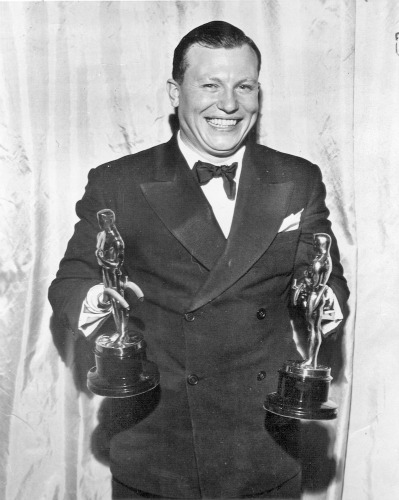
Harold Russell holds his two Oscars.
Harold Russell, who had never acted before, plays Homer Parrish, a young man who lost his hands in the Navy. He has a girlfriend back home (played by Cathy O'Donnell, Wyler's niece) whom he promised to marry--that is, before his injury. We see Homer grapple with the same issues as his two new friends--Fred and Al--but his are much deeper and more complicated. It is a shame Russell never acted again because he was a complete natural. In fact, in a film full of legendary actors and brilliant performances, Russell was actually the best of them all. A true revelation in talent, Harold Russell really did lose his hands in the war. Indeed, The Best Years of Our Lives is one of the only films I have ever heard of in which the actor playing a character with a disability actually had that disability. As a result, the most significant part of his performance is not how incredible it is that he could make us believe he lost his hands; his true acting talent is on display. In fact, Russell is the only actor in Oscar history to win two Academy Awards for the same performance: one for Best Supporting Actor, and one Honorary Award for bringing veterans hope. This is only one of many reasons, however, why this film remains a landmark and gold standard among films dealing with disability. 

Homer's struggles with coming to grips with his disability are the most honest and realistic I have ever seen in a movie. For the issue that is of highest concern for him is not adjusting to having no hands; that is the easy part. It is actually the social issues: people asking stupid questions and feeling entitled to information about his hands; feeling like a spectacle and an object of gossip, which the scene in which his little sister and her friends spy on him captures so deftly; feeling like less of a person because of his new reality; the monotony of having to explain again and again what happened to him and why he has hooks for hands; the anxiety over what he should do with his life; and feeling unworthy of anyone's love or attention. See, this is something The Theory of Everything--indeed, every other disability movie ever made--fails to understand: the greatest struggle in having a disability is convincing able-bodied people that you are still a person. Homer tells his Uncle Butch (played by jazz great Hoagy Carmichael) "I just don't want anyone pitying me. All I want is everyone to treat me like everyone else." I have yet to encounter any other film that captures this desire with such truth. 

This is one film that always makes me cry, and it is this scene that does me in every time. Homer finally lets his fiancee Wilma see what he looks like without his hooks. It is among the most romantic and beautiful scenes ever put on film. Go on and watch this clip. I dare you not to need a handkerchief: 


So beautiful.

Of course, The Best Years of Our Lives would be a classic even if Homer's story were the only one, but it is only one of three. Dana Andrews, who for some reason never achieved the kind of recognition afforded to Gary Cooper or any of the other leading men in his generation, is incredible here. His ability to emote is superb; he breaks my heart every time I watch this. He is married to, we learn later, shallow and haughty Marie, played with bitch-slap-inducing gusto by Virginia Mayo (trust me, you want to slap her, which is a testament to Mayo's talent). Fred falls in love with Al's daughter Peggy, played by Teresa Wright, whose shining eyes alone express so many emotions; she steals every scene she's in. Frederick March won an Oscar for Best Actor playing Al Stephenson, a banker whose drinking problem is also portrayed with sensitivity but not one trace of preachiness--a welcome change, for certain. Myrna Loy plays his wife Milly, and gives as good as she gets to March's character. 

As with physical disabilities, this film also touches on mental illness, examining what was then called Battle Fatigue but is now known as Post-Traumatic Stress Disorder (PTSD) movingly through Andrews's character. Not once is any term used to name his condition or preach to us; instead, we see what he is really facing in private moments. This scene, which is one of the most affecting montages I have ever seen, contains no dialogue; yet, we know exactly the thoughts and fears Fred is exorcising. 


The layers of symbolism here are staggering: the rows and rows of old planes now junk; the words "Round Trip?" written as a question on the side of this now discarded plane; the shadows and dust inside the plane--all of these elements, combined with Andrews's acting, Wyler's careful camera placement, and Hugo Friedhofer's emotive score, render this scene among the most impactful in a film bursting with impact. 

Speaking of William Wyler, there is perhaps no other American director responsible for so many classics: Wuthering Heights, Roman Holiday, The Heiress, Funny Girl, Jezebel, Ben Hur, Carrie (1952), Mrs. Miniver--I could go on and on. The Best Years of Our Lives, though, is his masterpiece. Wyler's style is deceptively simple: although we think he's not doing much because the camera stands still, he is in fact placing the camera in one specific spot to capture a specific emotional response that encapsulates all of the major players in the scene. One example from this film is the scene in which Fred calls Peggy to tell her he will not see her any more. While this phone call is taking place, Al is watching Butch and Homer play a duet on the piano together--that's right; this movie has a man with no hands learn the piano, which is one of many reasons to love it. To capture all of this action and emotional content, Wyler places the camera in front of Al's shoulder with Fred in a phone booth far in the back. This long shot keeps Al and Fred in equal focus, showing both of their perspectives and the flurry of emotions racing through both men simultaneously. Moreover, we hear the sound of the piano, and the long shot is intercut with shots of Butch and Homer playing. This shorter shot is also at an interesting angle: we see Homer, Butch, and Al in a line with Homer in front, allowing us, again to take in all of the myriad emotions in this scene. What results is Wyler showing us the many issues all characters are facing in only two alternating shots and no dialogue. Did I say William Wyler was a master or didn't I?

I can't say enough good things about this film, and I could write an entire book explaining why I love it so much. For the sake of brevity, I'll simply say The Best Years of Our Lives is a masterpiece, and I do not use that word lightly. If you've never seen it before, I envy you: you have the wonderful, thrilling, and inimitable chance to experience this film for the first time. 

Grade: A+


Sunday, September 13, 2015

Adam's Rib (1949)

This George Cukor-directed film is one of several classic pairings of Spencer Tracy and Katharine Hepburn. Interestingly, it was written by Garson Kanin and...Ruth Gordon. Yes, you know. The inimitable Ruth Gordon who played nosy Satanist Minnie Castevet in Rosemary's Baby to such perfection she became the first actor to win an Oscar for a horror film. 
Iconic shot of Ruth Gordon in Rosemary's Baby

Apparently, Ruth Gordon was an accomplished screenwriter before becoming an actress, and she was also close friends with Katharine Hepburn. 

Adam's Rib is a delight from beginning to end and is a surprisingly feminist movie--surprising when one considers the fact it was released in 1949. Spencer Tracy and Katharine Hepburn, who were together in real life, play married attorneys Adam and Amanda Bonner. Adam is a district attorney, Amanda a defense lawyer. Here's the trailer:


The film begins with Doris Attinger (played to perfection by another accomplished actress, Judy Holliday) tracking her philandering husband and shooting him in the shoulder while he is with his lover. She is arrested and charged with attempted murder. 

The next morning, the case makes the front page of the newspaper, which Adam and Amanda read together and which sparks a fierce debate between them: Amanda lectures Adam on double standards women face, especially before the law. When Adam arrives at work, he is appointed prosecutor to the case. When Amanda learns of this, she decides to become Doris Attinger's lawyer, and the gender debate begins full throttle! 

Honestly, this movie would be controversial for today, so I can only speculate about how audiences reacted to this film in 1949. During each courtroom scene Adam and Amanda question witnesses, and Amanda bases her entire case on women's inequality, showing the prosecution's witnesses no mercy when it comes to their own misogyny. In fact, during jury selection, her standard for each potential juror is whether they believe in women's equality. She tells the press and stresses in her opening statement that this case is about more than the defendant; it is about women being treated equally before the law. One of the most humorous and interesting scenes is when Amanda brings in high powered women as witnesses for the defense to prove women are equal to men. We see jaws drop and Amanda glowing with satisfaction as each of these witnesses describes how many degrees and positions she has. 

Although Spencer Tracy had top billing for this film, it is Katharine Hepburn with whom the audience identifies and for whom we cheer. The film portrays Amanda's case as more sophisticated and more important than Adam's, which is hammered home by his feckless closing argument in which he jumbles his words and makes little sense. Judy Holliday gives a smart, although supporting, performance as a woman who has suffered much physical abuse from her husband. In a rather touching scene in which she meets with her counsel (Hepburn) for the first time, she reluctantly recounts the times her husband beat her--all of which Amanda uses in her cross examination of the husband. 

The film ends on a comical note that does, to an extent, descend into the politics of its era (something that I expected and feel would have been impossible to avoid), but it rallies in the last scene, again stressing and celebrating women's right to equality. And it is hilarious: After Adam announces to Amanda that he will run as a Republican candidate for a judgeship, Amanda asks slyly if the Democrats have selected a candidate yet. I burst out laughing during this scene as I did many times throughout the film.

In addition, the film makes some interesting choices in its portrayal of marriage--choices that would be completely taboo in the fifties, if they were not already by 1949. For one, we see Adam and Amanda sharing one bed. From almost all movies of that era, husbands and wives had to have separate beds to avoid any possible reference to sex. Also, there is a rather hilarious (and, for its time, risque) scene in which Adam and Amanda, wearing only towels, give each other massages as they debate the case and women's rights. Something that is absent from the movie, interestingly, is children: not once do Amanda or Adam mention kids, and at the time this came out Hepburn and Tracy were in their 40s and 50s, respectively. We, in other words, are not exactly expecting Amanda to quit her job to have babies any time soon. By making Amanda a powerful attorney, one who works not just alongside her husband but who challenges him, and avoiding any reference to her as some sort of domestic goddess, the film confirms its arguments about equality (unlike The Thrill of it All (1963) that is relentlessly anti-feminist). 

All in all, Adam's Rib is a smart, funny, and progressive film that fully embraces feminism in a way that we don't even see now. You will find yourself cheering for Katharine Hepburn throughout. This is a classic for a reason. 

Grade: A

Friday, September 11, 2015

The Theory of Everything (2014)

I had put off watching The Theory of Everything for a while; the subject matter seemed incredibly depressing, and I was not in the mood to watch yet another biopic upon its release. The market was flooded with biopics last year, and this year's potential Oscar contenders appear to be continuing this trend. Moreover, as a Michael Keaton fan, I felt reluctant to watch the film that beat him at the Oscars this past year. In case you missed it, here is the trailer:


Putting my reservations aside, I finally watched The The Theory of Everything this evening and believe it might be the stuffiest, dullest, and most sanitized biopic I have ever seen--not to mention the only one in which the lead actor is in about one-third of the film. Yes, you read that correctly: Eddie Redmayne, who won an Oscar for his portrayal of beloved astrophysicist Stephen Hawking, was actually not in the film that much. The real main character? Hawking's wife, Jane, played with blandness and dispassion by Felicity Jones. 

There is little to admire about this film. The cinematography is the usual teal and orange combination that has saturated so many second rate productions these days. The oranges are aggressively orange, the blues aggressively blue--and poorly lit. There was only one scene that I felt was well shot, in fact, which was when Stephen and Jane kiss for the first time after viewing fireworks--an over used and predictable symbol, certainly, but one that was visually appealing. If only the actors' chemistry had matched the imagery. 

Eddie Redmayne's performance felt true and did provoke strong feelings of sympathy and sadness, but is that really what we want from a movie about a beloved figure with a severe disability? Do we really want to pity Stephen Hawking, or do we want to learn about the man--his thoughts, fears, anxieties, joys, and all of the inner workings of his brilliant mind? I'd take the latter, but this film indulges so deeply in the former that it ultimately feels like an experiment in making people with ALS as pitiful as possible. Yet, the film also failed to arouse much, if any pathos. An exercise in cliches, The Theory of Everything is insulting to Stephen in many ways. But I'm getting ahead of myself. 

As a feminist, I certainly yearn for woman-centric films; however, I felt this movie did itself a disservice by focusing so little on Stephen Hawking as a person and instead concentrating most of its energy, storytelling, and themes on Jane's life as drudgery because she married and altruistically cared for her husband. There are many scenes without Stephen and we are expected to sympathize with Jane for being trapped in a marriage with few rewards. Without question, Jane--and all caretakers, for that matter--suffered truly; however, the film robs Stephen of his humanity by not allowing the audience to understand how he must feel. It's a misconception to believe the caretaker suffers more than the person with the disease. As I watched the film, I kept wondering how Stephen must feel (and have felt in real life) about the horrendous changes his body endured; I wanted to know what was going on in his mind, but the film denies us even a glimpse into his experiences and accidentally fulfills a prediction made by Stephen's doctor. When he is diagnosed with ALS, the doctor explains that Stephen will still have thoughts, but "no one will know what they are"; indeed, we the audience never really do know what they are. All you are actually expected to feel (or know) is a romantic thrill over Jane meeting Jonathan and finding love again--an insult to Stephen Hawking, for certain.

Another flaw in the Jane/Stephen depiction is the lack of any chemistry whatsoever between its leads. Eddie Redmayne did do an excellent job playing a man whose body is deteriorating so rapidly and severely, but his costar seemed bored to be there. I found their romantic scenes together unbelievable (in the true sense of the word, not the superlative), and I stress "romantic" rather than "love" because love, and all its complexities, is perhaps the most interesting part of Stephen's life that was completely sanitized in this film to a distressing and irritating extent. 

After Stephen is diagnosed with ALS and he and Jane marry, we are shown a montage shot to resemble a family movie, but this montage skims over their wedding, early married life, and birth of their first child all in a matter of about 90 seconds. I do not at all mean this in a pornographic way, but the refusal to explore Stephen's sexuality (or anything else about his internal thoughts) hurt the film tremendously. Again, I kept wondering how he felt about himself and his wife: What insecurities did he have? What was his attitude toward intimacy? What was their married life like in the beginning--how they communicated, spent time together, worked, talked, interacted? How did they handle the ways his body changed? How did he feel about becoming a father in addition to beating the two-year prognosis he was given? How were the later years different? There are endless questions that the movie refuses to explore. Even when the film implies Stephen has fallen in love with Elaine, his nurse and second wife, we are still denied any exploration of his feelings. True, there are a few humorous comments about how Stephen's, um, "ability" is now "automatic" and we learn he likes to read Penthouse, but there is nothing substantive or honest about this portrayal. The births of his other children are handled with similar stuffy distance, which irritated me and, in a way, is an insult to Stephen Hawking: we can't learn anything about his fears, desires, or emotions in general because, gasp!, he's in a wheelchair; we see Stephen the ALS patient, not Stephen the man. I kept mentally comparing this film to My Left Foot, which is by no means a perfect film, but one that does honor Christie Brown's life more honestly and respectfully than this film does Stephen Hawking. 

The movie actually left me unsettled, and I finally realized why hours later: the film objectifies Stephen. We do see the world partly through his perspective...until his diagnosis. After the doctor tells him no one will ever know his thoughts, Stephen becomes an object of pity and scorn and is portrayed as a burden on his wife and family and everyone around him. Indeed, the way we learn ALS is serious is because we see his friend's reaction: Stephen explains what ALS is when his friend comes to his dorm room. As Stephen speaks, the camera focuses on his friend's face and his friend's growing fear and sadness; we identify with the able-bodied character and no longer with Stephen. We feel upset because the friend is upset--not because we understand how Stephen feels. The entire film is like this, privileging the able-bodied perspective over Stephen's, making this one of the most egregiously offensive films to people with physical disabilities, including Stephen Hawking. 

In short, this movie is a lifeless, bloodless, and ultimately disparaging morass of dishonest emotion and cheap attempts at pity. I respect Eddie Redmayne tremendously as an actor, but this film really is beneath his talent. I do look forward to his work in the future and believe he has a long and rewarding career ahead of him, but I hope this is not the one role that will define his entire filmography. 

Grade: D