Showing posts with label black&white. Show all posts

Saturday, December 3, 2016

The Heiress (1949)

This week's film is William Wyler's 1949 masterpiece, The Heiress, starring Olivia de Havilland, Montgomery Clift, Ralph Richardson, and Miriam Hopkins. 


Based on the 1881 novel Washington Square by Henry James, The Heiress was adapted into a stage play before becoming a film. Olivia de Havilland was actually encouraged to see the play and told that it would be a perfect vehicle for her; after she saw it, she immediately contacted William Wyler, who upon seeing the play remarked, "Let's do it."

James was inspired to write Washington Square by an incident he heard about involving a manipulative but handsome young man who courted an introverted, "dull" young woman simply for her money. Rather than craft a predictable, melodramatic tale of an unsuitable suitor, however, James instead created a far more complex story, mostly due to his cultivating a less obvious but more cunning, malicious, and grotesque villain: the father. The film of The Heiress follows the novel's themes and story closely, and it is this unexpected characterization that fuels the drama and emotions of the film. 

The story, set in the 1840's, is deceivingly simple: Catherine Sloper (de Havilland) is a young, awkward woman whose deceased mother has left her $10,000 a year; her father, Dr. Austin Sloper, played to perfection by the late-great Ralph Richardson, promises to leave her an additional $30,000 per year on the prerequisite that she marry someone he approves of. Enter Morris Townsend (Montgomery Clift), a man we the audience are never completely sure we can trust. Morris and Catherine's courtship comes to a devastating and heart-wrenching end in one of the most memorable scenes in the film. 

Olivia de Havilland's performance in The Heiress is perhaps her most popular, rivaling only her role as Melanie Hamilton in Gone with the Wind. Celebrating her 100th birthday this year, de Havilland is the last surviving cast member of Gone with the Wind and enjoys a carefree life in Paris. In this film, the way she uses her voice is one of the most enduring aspects of her performance. In the beginning, she is exceedingly awkward and shy, but also exudes the desperation Catherine feels simply to be loved. Her reactions to her father's increasingly direct cruelty are realistic and at times painful to watch. Similarly, the rapture in her face and especially her eyes when Morris courts her is both moving and painful - painful when one knows the outcome awaiting Catherine. In the most moving sequence of the film, when Morris has abandoned her after promising to return in a few hours for their elopement, Catherine's cauldron of emotions - hurt, humiliation, shame, anger, and despair - culminate in the growing tension in de Havilland's face and the explosion of emotions as the clock strikes. The look on her face as she lurches up the stairs the next day, the sight of the morning sunrise visible from the upper window, is cutting to watch. After that scene, the sweet lilt to her voice is gone along with her innocence; by the end of the film, Catherine is a woman one can hardly recognize. It is a terrific performance and definitely my favorite de Havilland role. 

The themes of the movie are complex and definitely do not align with expected Hollywood stories, neither from the 1940's, nor today. Frankly, it's even less likely for a movie in today's market to have the daring and aggressively anti-Hollywood ending that The Heiress handles so deftly. 


For one, the question of materialism and class is central to the film's actions and emotional content. Is Morris simply a fortune hunter, or is there genuine feeling on his part? To what extent would it matter? Thanks mostly to Montgomery Clift's acting, we can never completely trust or distrust Morris. His affection seems genuine, but his actions are at best dubious. Does he abandon Catherine because she tells him she has disinherited herself, or is he panicked about his role in disinheriting her, or does he want to try to make his own fortune? We never really know. The film suggests the answer is complicated and involves a bit of each of these suspicions. William Wyler, who was a master at the deceivingly simple, places the camera in the first two acts so that we only see Catherine's face when she speaks to Morris. In her last conversation with Morris, the camera and the actors' positions finally shift so that we see Morris's reaction. This simple but provocative shift is so subtle that one might miss it on the first viewing, but it sends a strong message to the audience, almost subconsciously. Likewise, Catherine's treatment of Morris in the end is both disturbing and satisfactory, the final scene never ceasing to give me chills. This again speaks to the dual story lines in Henry James: the surface, and beneath the surface. On the surface, Morris is a fortune hunter and a rake, but beneath that is a far more sinister plot involving a far more sinister villain: the father. 

Ralph Richardson plays Austin Sloper with arrogance and cruelty. His malignant grin and cold sneer are but a few of the elements that makes one despise this character. He purposely interjects himself into Catherine's relationship with Morris, supposedly because he is concerned about her future. Yet, Austin constantly compares Catherine to her dead mother, complaining that she will never compare to her mother's beauty, grace, intelligence, or charm, which leads to deeper questions of his motivations: why does he care so deeply about Catherine marrying Morris? Does he truly worry about his fortune going into Morris's hands, or is there something darker behind his motivations? 

It is worth noting that both Morris and Austin are materialistic characters; in fact, Austin may be even worse because the one thing he cares about above all else is his money: more than his estate, his patients, his family, and even more than his own daughter. In one of the most chilling scenes of the film, Austin announces to Catherine that her one and only virtue is her money. In his words, "there are a thousand girls who are prettier, a thousand more clever." Think about: Austin has told his own flesh and blood that she has absolutely no redeeming qualities beyond the money, which he controls. Considering Morris is at least kind to her and does make her feel good about herself, it is little wonder that she falls for Morris. This revelation drives a permanent stake in Catherine's relationship with her father and is difficult to watch. 

When one takes a moment to think about the story taking place beneath the surface, The Heiress is actually quite a creepy tale of a father and a suitor each trying to "own" Catherine as a possession, a symbol of their respective statuses and wealth, a token to be won. This conflict between Catherine and Austin is tinged with a sexual undercurrent in that Austin wishes to recreate his deceased wife, but is angered by his daughter's inability to fill this role. 

It should be noted that Aaron Copeland composed the magnificent score, which adds even more depth and emotion to an already deep and emotional film. Although Wyler was never a director known for obvious "camera tricks," his directing is exacting and calculated. Each shot, each image, each actor is placed deliberately, as if each shot were a painting. 

Truly, The Heiress is a film in which everything came together perfectly: acting, production design, story, music, directing. Olivia de Havilland won her second Academy Award for this film (the first was for To Each His Own from 1946). Montgomery Clift, who had almost immediate success with two films in 1948 (Red River and The Search), cemented his status as a leading man with his subtle and intelligent performance here. Clift was a brilliant actor and was also the first American Method actor on film, not Marlon Brando, who had his breakout role in 1950 with A Streetcar Named Desire. Inconceivably, Clift was also yet another incredible talent who never won an Oscar.  

In short, The Heiress is a masterpiece and a film that begs to be watched over and over, its power and complexities never dulling over time. 

Grade: A+


Sunday, May 1, 2016

The Apartment (1960)

Although he's not discussed much any more among film buffs, Billy Wilder was truly one of America's greatest directors, and The Apartment is one of the most exemplary of his works. Here is the trailer:


From 1960, The Apartment stars Jack Lemmon, Shirley MacLaine, and Fred MacMurray in what is undoubtedly a raw and emotional film about loneliness, suicide, and sex all dressed up as a romantic comedy. As Wilder fans know, a Billy Wilder movie is always tinged with darkness no matter how light the subject matter. Sabrina, Stalag 17, Sunset Boulevard, Some Like It Hot, Ace in the Hole - all of these films, while technically comedies, are laced with darkness throughout (especially Ace in the Hole and Sunset Boulevard). The dramedy is common place today, but Wilder kind of invented it. 

C.C. "Bud" Baxter (Lemmon) works at a massive New York insurance company and has trouble saying "No." Four executives at the company have bribed him into lending them the key to his apartment where they each bring girls from the office over to have sex. Baxter's neighbors assume he is a wild gigolo, and there are some humorous - if not icky - complaints about all of the "noise" his neighbors are sick of hearing. Baxter clearly hates his situation, but also does not know what else to do; if he refuses any of these men, he will lose his job. As a result, his apartment has a reputation throughout the company as a safe place for trysts. 

This situation balloons when the president of the insurance company, J.D. Sheldrake (MacMurray), offers Baxter a promotion in exchange for his own personal key to the apartment. Never one to say no, Baxter goes along with this. To make matters more complicated, the woman Baxter is in love with, Fran Kubelik (MacLaine), who works as an elevator girl, is having an affair with Sheldrake and goes with him to Baxter's apartment. 

The levels of conflict in this film are almost suffocating, as are the sexual conundrums. Think about it: the object of Baxter's affection is not only having sex with his boss but in his own bed. This would be considered racy today, and no doubt was shocking in 1960. Although Wilder does have some comedic elements in this situation, the film takes a serious and dark turn quickly. In fact, for a comedy, there is actually very little to laugh about in this film, which I think is one reason to admire it. Making an already sad and distressing situation sad and distressing is not really that interesting. Finding the humor, though, in something sad and distressing, and using that humor to make some very serious statements about gender, sexuality, and power takes skill, which Wilder had in spades. 


The acting in this film is excellent across the board (as usual in Billy Wilder movies), but the true revelation here is Fred MacMurray, who soars in a very, very different role for him. Known for "father knows best" sort of roles in Disney movies like The Shaggy Dog or the television show My Three Sons, MacMurray's acting in this film is jarring, to say the least. His image as "the dad" from so many films is shattered as he plays a lecherous, cruel, and narcissistic brute who savors controlling his employees and thrives off of seducing women. The first time I saw this film his performance surprised me the most. It was a brilliant choice in casting that actually works in the film's favor; you don't expect him to be so sadistic based on previous expectations. When you realize how disgusting his character is, you are just as shocked as the characters in the film are. Imagine Hugh Grant playing a serial killer and that should give you some idea about how jarring it was for audiences in 1960 to see MacMurray in this light. 


Shirley MacLaine gives a moving performance as Miss Kubelik. Her scenes with MacMurry are painful to watch because her face reveals her character's emotions with such rawness. No matter how many times I've watched it, the scene at the Chinese restaurant still brings tears to my eyes. Her character's journey also takes an unexpected turn in one of the most moving sequences about a drug overdose you will ever see. 

Jack Lemmon is, of course, perfection. Seriously, the man never made a bad movie. He could do anything - comedy, drama, farce - and we get a taste of his range in this film as Baxter's conscience develops. He clearly resents his neighbors' assumptions about his character but does not know how to reverse it - to say nothing of how disturbing it is that his superiors at work use his bed for sex almost every night. He is extremely lonely, and the film hammers this home in a moving, if humorous, way when he tries to watch television after a long day and eats a nasty TV dinner. 

The cinematography is gorgeous in black and white. With a clever use of lighting and shadows, Wilder is able to make an already dark and unsettling situation that much more moving. I personally prefer black and white movies, and The Apartment is one example of why. Every scene is exploding with emotion because of the way they are lit. Even as I watched it tonight, I felt anxious and distressed throughout much of it despite knowing what was going to happen. That is Wilder's power as a director. 

One thing that should be noted is 1960 was an excellent year for movies: Psycho, La Dolce Vita, The Time Machine, Elmer Gantry, The Entertainer, BUtterfield 8, Inherit the Wind, Spartacus, The Alamo, Sons and Lovers, The Virgin Spring. Truly, 1960 rivals 1939 as one of the greatest years for films, and The Apartment is a worthy addition, winning five Oscars for Best Director, Best Original Screenplay, Best Film Editing, Best Art Direction (B&W), and Best Picture. It really is a perfect movie; I can think of nothing that should have been done differently or would have improved it. 

Although there are comedic elements, The Apartment as a whole is an intense and moving film about suicide, living alone, and sexual exploitation. Truly, you would be hard pressed to find another film from that era that takes such bold and adult content and presents it so movingly. Without a doubt, The Apartment is a work of art and one of Billy Wilder's best. 

Grade: A+

Saturday, October 3, 2015

Raging Bull (1980)

Last night I watched Raging Bull for the fifth or sixth time (I have lost count), and I still have at best mixed feelings about it. From a directing standpoint, an editing standpoint, an acting standpoint, a cinematography standpoint--truly, any aspect of filmmaking--Raging Bull is a masterpiece. However, there is something missing from the film for me that weakens its pathos and overall emotional pull. At just over two hours, it feels much longer. It is a beautiful film in many ways, but may also be the most violent film Martin Scorsese has ever made by a tremendous margin. 

Released in 1980, which was the same year of David Lynch's The Elephant Man, Robert Redford's directorial debut in Ordinary People, and Sissy Spacek's lovely performance in Coal Miner's Daughter, Raging Bull certainly was in good company. I've seen all of these movies and enjoy them all for different reasons, but Raging Bull is the one that haunts me the most, and not for necessarily good reasons. 

The film chronicles real life boxer Jake LaMotta's rise and fall in his boxing career, and it is a brutal, agonizing decline. Robert De Niro, whose performance is perfection here, got into incredible shape for the boxing sequences, then gained over 60 pounds to play LaMotta in his later years. It is a breathtaking transformation and one that anyone even mildly interested in acting or film must see. He captures LaMotta's anger, stupidity, paranoia, and (in my opinion) personality disorder flawlessly. One of the most perfectly shot, edited, and acted scenes is his final fight with Sugar Ray Robinson. If you've never seen this film before, you must watch this:


The editing in this scene is brilliant. Spike Lee points out that one of the greatest things about this movie is the boxing choreography, and it is perfect. The cuts of the lights, the punches, the blood--we learn so much about LaMotta as a person through these boxing sequences, and none more than in the clip above.

Although Raging Bull is recognized as one of the great collaborations between Robert De Niro and Martin Scorsese, many people fail to realize this was the first in a long and masterful line of collaborations between Scorsese and Thelma Schoonmaker, who is without a doubt one of the great editors of the sound era. If you feel I'm overstating, just watch this interview with Scorsese and Wang Kar Wai in which they both gush over Schoonmaker's talent (13:00 minutes in):


Since 1980, Thelma has edited all of Scorsese's movies and now practically has a telepathic relationship with him. She's been nominated seven times for Best Film Editing, and she's won three Oscars--the first of which was for Raging Bull (The Aviator  and The Departed were her other wins). For some reason, every self-described feminist I know who is interested in film does not know anything about Schoonmaker, which bewilders me and speaks to how much editors are overlooked, especially women. In any case, Scorsese and Schoonmaker's collaboration on Raging Bull is nothing short of ingenious. The cuts on the Sugar Ray sequence are of course only one small example.

This film also marks the first collaboration between Scorsese and Joe Pesci. Anyone who is familiar with their later work, particularly Goodfellas and Casino, knows that in the Pesci-De Niro relationship, De Niro plays the calm one and Pesci the psychopath. In Raging Bull, the relation is much the opposite, with Jake LaMotta as essentially a paranoid, narcissistic psychopath (he is a "raging bull") and Pesci as the slightly more level-headed brother. Truly, Raging Bull is an American Othello, with LaMotta constantly suspecting and punishing his Desdamona, played by an extremely young Cathy Moriarty. 

So, with all of these accolades, why do I dislike this movie?

It's complicated. The first time I watched this film was in the midst of my and my brother's obsession with Scorsese's Goodfellas, which you can read about on my "About Me" page. We were in love with anything even remotely associated with Scorsese and wanted to see Raging Bull as soon as we knew what it was. I still remember Burt and me watching it on an old TV in our living room and both of us feeling...confused by the end. I don't know what I expected, but I do remember feeling let down. Because I was only about 17 at the time, it is easy to dismiss my initial reaction to youthful ignorance. However, I've watched it since then several times and always carry that same feeling of...disappointment. After watching the film last night, I am finally able to articulate that disappointment. 

Jake LaMotta is a character consumed by violence; it defines every fiber of his being: his masculinity, his passions, his home life, his career, his treatment of his family. He is a man who is drowned in violence, defined by it, driven by it, aroused by it. As a result, every single scene of the film is at the very least tinged with this violence. Watching the film last night, I felt emotionally exhausted only thirty minutes into the movie, and it was then that I realized why. 

The film puts you inside the mind of a man--a "raging bull"--whose obsession with violence permeates everything about him, and it fills the audience with anxiety, fear, and trepidation. You have no idea whom he is about to attack, what he will break or destroy, or to what extent he will explode. He is a ticking time bomb in the most extreme. If you look at other Scorsese protagonists, this is not an unusual characteristic; in fact, it is quite common. Johnny Boy in Mean Streets, Travis Bickle in Taxi Driver, Nicky in Casino, Tommy in Goodfellas--all of these guys are on the brink of explosion. For me, the difference is that LaMotta was not only a real person (this is a biopic, after all), but his anger and intensity feel so real. It is because of this constantly pulsing violence throughout the entire film that I believe Raging Bull is the most violent film Scorsese has ever done.

I can only speculate about how men feel watching Raging Bull, but for me as a woman, I feel anxious and tired the whole time. Although I have never been in a violent relationship, I have been on the receiving end of that kind of attitude LaMotta exudes: women as property, women as sexual objects, women as things. Indeed, every woman alive (and most girls) have been subjected to sexual harassment at some point (usually quite frequently), and the Jake LaMottas of the world are the ones we fear most of all. 

One scene in particular that made me feel queasy--in a way it did not when I was a teenager--was toward the end. LaMotta has a club and is quite fat and creepy at this point. He walks around the club kissing girls who may or may not be underage as a way to "test" and see if they are 21. I had to stop the film and walk around for a moment to calm down; De Niro's performance in that scene is so real, it provoked memories of every creepy, lecherous old man I've met at practically any social function: The ones who walk over to girls, sometimes still teenagers, and attempt to flirt by asking, "What's a pretty little girl like you doing here?" That familiarity and the underlying violence beneath it--sexual violence, violence that we as an audience know LaMotta is not afraid of using to get his own way, violence that threatens any woman who does not adhere to his idea of women as property--actually scared me; I say that without hyperbole. 

When we learn in a subsequent scene that one of the girls was only 14, and LaMotta is arrested, I had trouble sympathizing with him. In fact, I really have no sympathy for his character throughout the film, which I think compromises it. Although it is true almost Scorsese's entire filmography is about "bad people," I do not have trouble identifying or feeling interested in the protagonists of his other films, even the gangster pictures or The Wolf of Wall Street. Raging Bull, on the other hand, leaves me feeling nothing but revulsion and mercy when the final credits come. I don't really feel bad for him at all and struggle to empathize with anything that happens to him. 

One thing I would like to add is that over the years, critics have accused Scorsese of being misogynist, but I find that misguided at best. In Raging Bull, you are put inside the mind of a misogynist, and it is a creepy, unsettling place to be. The film, and almost all of Scorsese's movies, is an indictment of many of the things we associate with masculinity: violence, treating women like property, domination. There is nothing in this film indicating Scorsese endorses this behavior, but he forces you to experience it. I suppose this is one reason why I find this film so emotionally draining. 

All in all, Raging Bull is an exhausting, laborious movie to watch, but there is much to admire about it. I can see why people love it, and I do appreciate the many artistic elements of it; that doesn't mean I enjoy watching it. 

Grade: B+

Thursday, September 24, 2015

The Best Years of Our Lives (1946)

I felt compelled tonight to watch one of my all-time favorite films, The Best Years of Our Lives (1946). Directed by the immaculate William Wyler, this film follows the lives of three service men as they adjust to civilian life: Fred Derry (Dana Andrews) from the Air Force; Al Stephenson (Frederick March) from the Army; and Homer Parrish (Harold Russell) from the Navy. The men meet in an airport, struggling to return to their home in Boone City--a fictional town whose name is as American as you can get. What follows is an intricate, intimate, and emotionally rich examination of precisely what happens when one returns from war. 

The Best Years of Our Lives is primarily thought of as a veterans' film--the ultimate veterans' film, in fact; however, I feel this summation not only oversimplifies this complex and beautiful film, but also grossly distorts the magnitude of the issues Wyler explores: alcoholism, culture shock, love, and above all disability. The Best Years of Our Lives is the first film to explore disability honestly, and it remains the greatest. Judging from the insulting crop of disability-related films we are privy to today (The Theory of Everything, anyone?), I'd say The Best Years of Our Lives will remain peerless for a very long time. 

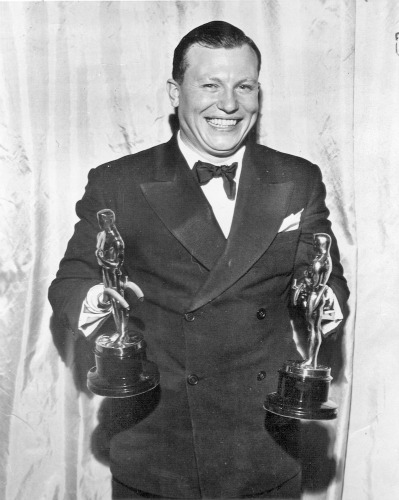
Harold Russell holds his two Oscars.
Harold Russell, who had never acted before, plays Homer Parrish, a young man who lost his hands in the Navy. He has a girlfriend back home (played by Cathy O'Donnell, Wyler's niece) whom he promised to marry--that is, before his injury. We see Homer grapple with the same issues as his two new friends--Fred and Al--but his are much deeper and more complicated. It is a shame Russell never acted again because he was a complete natural. In fact, in a film full of legendary actors and brilliant performances, Russell was actually the best of them all. A true revelation in talent, Harold Russell really did lose his hands in the war. Indeed, The Best Years of Our Lives is one of the only films I have ever heard of in which the actor playing a character with a disability actually had that disability. As a result, the most significant part of his performance is not how incredible it is that he could make us believe he lost his hands; his true acting talent is on display. In fact, Russell is the only actor in Oscar history to win two Academy Awards for the same performance: one for Best Supporting Actor, and one Honorary Award for bringing veterans hope. This is only one of many reasons, however, why this film remains a landmark and gold standard among films dealing with disability. 

Homer's struggles with coming to grips with his disability are the most honest and realistic I have ever seen in a movie. For the issue that is of highest concern for him is not adjusting to having no hands; that is the easy part. It is actually the social issues: people asking stupid questions and feeling entitled to information about his hands; feeling like a spectacle and an object of gossip, which the scene in which his little sister and her friends spy on him captures so deftly; feeling like less of a person because of his new reality; the monotony of having to explain again and again what happened to him and why he has hooks for hands; the anxiety over what he should do with his life; and feeling unworthy of anyone's love or attention. See, this is something The Theory of Everything--indeed, every other disability movie ever made--fails to understand: the greatest struggle in having a disability is convincing able-bodied people that you are still a person. Homer tells his Uncle Butch (played by jazz great Hoagy Carmichael) "I just don't want anyone pitying me. All I want is everyone to treat me like everyone else." I have yet to encounter any other film that captures this desire with such truth. 

This is one film that always makes me cry, and it is this scene that does me in every time. Homer finally lets his fiancee Wilma see what he looks like without his hooks. It is among the most romantic and beautiful scenes ever put on film. Go on and watch this clip. I dare you not to need a handkerchief: 


So beautiful.

Of course, The Best Years of Our Lives would be a classic even if Homer's story were the only one, but it is only one of three. Dana Andrews, who for some reason never achieved the kind of recognition afforded to Gary Cooper or any of the other leading men in his generation, is incredible here. His ability to emote is superb; he breaks my heart every time I watch this. He is married to, we learn later, shallow and haughty Marie, played with bitch-slap-inducing gusto by Virginia Mayo (trust me, you want to slap her, which is a testament to Mayo's talent). Fred falls in love with Al's daughter Peggy, played by Teresa Wright, whose shining eyes alone express so many emotions; she steals every scene she's in. Frederick March won an Oscar for Best Actor playing Al Stephenson, a banker whose drinking problem is also portrayed with sensitivity but not one trace of preachiness--a welcome change, for certain. Myrna Loy plays his wife Milly, and gives as good as she gets to March's character. 

As with physical disabilities, this film also touches on mental illness, examining what was then called Battle Fatigue but is now known as Post-Traumatic Stress Disorder (PTSD) movingly through Andrews's character. Not once is any term used to name his condition or preach to us; instead, we see what he is really facing in private moments. This scene, which is one of the most affecting montages I have ever seen, contains no dialogue; yet, we know exactly the thoughts and fears Fred is exorcising. 


The layers of symbolism here are staggering: the rows and rows of old planes now junk; the words "Round Trip?" written as a question on the side of this now discarded plane; the shadows and dust inside the plane--all of these elements, combined with Andrews's acting, Wyler's careful camera placement, and Hugo Friedhofer's emotive score, render this scene among the most impactful in a film bursting with impact. 

Speaking of William Wyler, there is perhaps no other American director responsible for so many classics: Wuthering Heights, Roman Holiday, The Heiress, Funny Girl, Jezebel, Ben Hur, Carrie (1952), Mrs. Miniver--I could go on and on. The Best Years of Our Lives, though, is his masterpiece. Wyler's style is deceptively simple: although we think he's not doing much because the camera stands still, he is in fact placing the camera in one specific spot to capture a specific emotional response that encapsulates all of the major players in the scene. One example from this film is the scene in which Fred calls Peggy to tell her he will not see her any more. While this phone call is taking place, Al is watching Butch and Homer play a duet on the piano together--that's right; this movie has a man with no hands learn the piano, which is one of many reasons to love it. To capture all of this action and emotional content, Wyler places the camera in front of Al's shoulder with Fred in a phone booth far in the back. This long shot keeps Al and Fred in equal focus, showing both of their perspectives and the flurry of emotions racing through both men simultaneously. Moreover, we hear the sound of the piano, and the long shot is intercut with shots of Butch and Homer playing. This shorter shot is also at an interesting angle: we see Homer, Butch, and Al in a line with Homer in front, allowing us, again to take in all of the myriad emotions in this scene. What results is Wyler showing us the many issues all characters are facing in only two alternating shots and no dialogue. Did I say William Wyler was a master or didn't I?

I can't say enough good things about this film, and I could write an entire book explaining why I love it so much. For the sake of brevity, I'll simply say The Best Years of Our Lives is a masterpiece, and I do not use that word lightly. If you've never seen it before, I envy you: you have the wonderful, thrilling, and inimitable chance to experience this film for the first time. 

Grade: A+