The Best Years of Our Lives is primarily thought of as a veterans' film--the ultimate veterans' film, in fact; however, I feel this summation not only oversimplifies this complex and beautiful film, but also grossly distorts the magnitude of the issues Wyler explores: alcoholism, culture shock, love, and above all disability. The Best Years of Our Lives is the first film to explore disability honestly, and it remains the greatest. Judging from the insulting crop of disability-related films we are privy to today (The Theory of Everything, anyone?), I'd say The Best Years of Our Lives will remain peerless for a very long time.
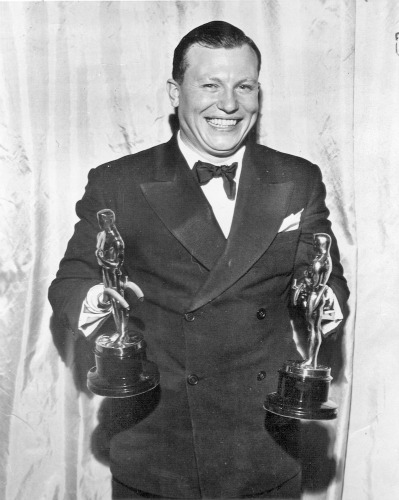 |
| Harold Russell holds his two Oscars. |
Homer's struggles with coming to grips with his disability are the most honest and realistic I have ever seen in a movie. For the issue that is of highest concern for him is not adjusting to having no hands; that is the easy part. It is actually the social issues: people asking stupid questions and feeling entitled to information about his hands; feeling like a spectacle and an object of gossip, which the scene in which his little sister and her friends spy on him captures so deftly; feeling like less of a person because of his new reality; the monotony of having to explain again and again what happened to him and why he has hooks for hands; the anxiety over what he should do with his life; and feeling unworthy of anyone's love or attention. See, this is something The Theory of Everything--indeed, every other disability movie ever made--fails to understand: the greatest struggle in having a disability is convincing able-bodied people that you are still a person. Homer tells his Uncle Butch (played by jazz great Hoagy Carmichael) "I just don't want anyone pitying me. All I want is everyone to treat me like everyone else." I have yet to encounter any other film that captures this desire with such truth.
This is one film that always makes me cry, and it is this scene that does me in every time. Homer finally lets his fiancee Wilma see what he looks like without his hooks. It is among the most romantic and beautiful scenes ever put on film. Go on and watch this clip. I dare you not to need a handkerchief:
So beautiful.
Of course, The Best Years of Our Lives would be a classic even if Homer's story were the only one, but it is only one of three. Dana Andrews, who for some reason never achieved the kind of recognition afforded to Gary Cooper or any of the other leading men in his generation, is incredible here. His ability to emote is superb; he breaks my heart every time I watch this. He is married to, we learn later, shallow and haughty Marie, played with bitch-slap-inducing gusto by Virginia Mayo (trust me, you want to slap her, which is a testament to Mayo's talent). Fred falls in love with Al's daughter Peggy, played by Teresa Wright, whose shining eyes alone express so many emotions; she steals every scene she's in. Frederick March won an Oscar for Best Actor playing Al Stephenson, a banker whose drinking problem is also portrayed with sensitivity but not one trace of preachiness--a welcome change, for certain. Myrna Loy plays his wife Milly, and gives as good as she gets to March's character.
As with physical disabilities, this film also touches on mental illness, examining what was then called Battle Fatigue but is now known as Post-Traumatic Stress Disorder (PTSD) movingly through Andrews's character. Not once is any term used to name his condition or preach to us; instead, we see what he is really facing in private moments. This scene, which is one of the most affecting montages I have ever seen, contains no dialogue; yet, we know exactly the thoughts and fears Fred is exorcising.
The layers of symbolism here are staggering: the rows and rows of old planes now junk; the words "Round Trip?" written as a question on the side of this now discarded plane; the shadows and dust inside the plane--all of these elements, combined with Andrews's acting, Wyler's careful camera placement, and Hugo Friedhofer's emotive score, render this scene among the most impactful in a film bursting with impact.
Speaking of William Wyler, there is perhaps no other American director responsible for so many classics: Wuthering Heights, Roman Holiday, The Heiress, Funny Girl, Jezebel, Ben Hur, Carrie (1952), Mrs. Miniver--I could go on and on. The Best Years of Our Lives, though, is his masterpiece. Wyler's style is deceptively simple: although we think he's not doing much because the camera stands still, he is in fact placing the camera in one specific spot to capture a specific emotional response that encapsulates all of the major players in the scene. One example from this film is the scene in which Fred calls Peggy to tell her he will not see her any more. While this phone call is taking place, Al is watching Butch and Homer play a duet on the piano together--that's right; this movie has a man with no hands learn the piano, which is one of many reasons to love it. To capture all of this action and emotional content, Wyler places the camera in front of Al's shoulder with Fred in a phone booth far in the back. This long shot keeps Al and Fred in equal focus, showing both of their perspectives and the flurry of emotions racing through both men simultaneously. Moreover, we hear the sound of the piano, and the long shot is intercut with shots of Butch and Homer playing. This shorter shot is also at an interesting angle: we see Homer, Butch, and Al in a line with Homer in front, allowing us, again to take in all of the myriad emotions in this scene. What results is Wyler showing us the many issues all characters are facing in only two alternating shots and no dialogue. Did I say William Wyler was a master or didn't I?
I can't say enough good things about this film, and I could write an entire book explaining why I love it so much. For the sake of brevity, I'll simply say The Best Years of Our Lives is a masterpiece, and I do not use that word lightly. If you've never seen it before, I envy you: you have the wonderful, thrilling, and inimitable chance to experience this film for the first time.
Grade: A+

This review is excellent for being well-written, and for accurately capturing the artistry of the director, cast and crew, and vividly describing the timeless humanity of the story. My wife and I had our three children watch this film when they about twelve years old. We watch it every Veterans' Day. Great job by our Blogger!
ReplyDelete